
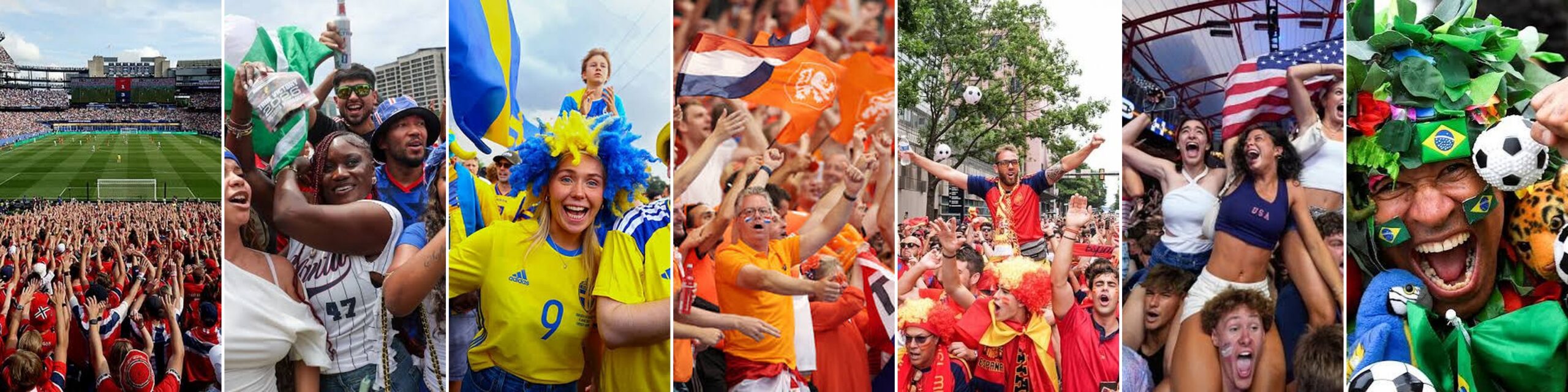
For years, we’ve been sold a bleak forecast: a flattened, borderless, algorithm-fed future where culture is homogenized, identity is optional, and human connection is outsourced to machines. A world managed by systems, not people.
Then the World Cup happened. And the forecast fell apart in the most joyful way imaginable.
Forty-eight nations came to North America this summer for the largest World Cup in history, played across 104 matches in 16 cities spanning the United States, Canada and Mexico. And here’s what nobody can deny after watching a single match day: national identity is not dying. It is thriving, gloriously, in full color.
Norwegian fans thundering their Viking Row. Scottish supporters marching through New England in kilts, bagpipes wailing. Mexican fans turning stadiums into cathedrals of green. Argentine faithful singing for Messi with a devotion no algorithm could manufacture. Colombians, Moroccans, Japanese, Senegalese, each arriving wrapped in their flags, their songs, their food, their grandmother’s superstitions.
This wasn’t tribalism. It was the opposite. It was a rich quilt of distinct national identities, stitched together by a single shared goal. Nobody had to surrender who they were to belong. That’s the part the prophets of the borderless, one-world monoculture never understood: unity doesn’t require sameness. The most connected month in human history was also the most proudly, defiantly national.
Something else happened this summer, quieter than the matches, but maybe more important.
Millions of international fans arrived carrying a picture of America painted for them by corporate media and doom-scrolling feeds: divided, hostile, dangerous. Then they actually got here. And they started posting.
A British fan went viral saying, simply, “We owe America a huge apology,” because the country he found was nothing like the one his screens had promised. The clips came in waves: fans marveling at free refills and strangers’ kindness, an Australian creator invited onto a Miami boat by an American he’d never met, visitors welcomed onto Texas ranches, into tailgates, into people’s actual lives. Pilgrimages to Waffle House at 1 a.m. Buc-ee’s treated like a national monument.
One meme captured it perfectly: the World Cup was America having a giant sleepover with the cousins we never get to see because our parents don’t get along.
Think about what that means. The most powerful perception-correction campaign in modern history wasn’t run by a government, a brand, or a broadcaster. It was run by ordinary people with phones, telling the truth about their own experience, and it dismantled decades of manufactured narrative in about four weeks.
As someone who came to this country from another one, I felt this in my bones, because I’ve watched a World Cup do this to a nation before.
In 2010, South Africa, the country of my birth, hosted the first World Cup ever played on African soil. The world arrived carrying its own distorted picture of us: crime, chaos, a country that couldn’t possibly pull it off. What they found instead was a nation that opened its arms, and a sound they’d never heard: the vuvuzela. That plastic horn was born that winter, and it took over the country. Deafening, joyful, utterly ours. The commentators complained. We blew louder. For one month, a country still learning how to be one people found a single voice, and it changed us in ways we could not have imagined. Strangers of every race danced together in fan parks. We discovered that the world’s perception of us was wrong, and more importantly, that our perception of each other had been wrong too.
Watching international fans fall in love with the real America this summer, I recognized every frame of it. Different country, same revelation. And here’s the detail that gives me chills: Spain won that 2010 final too. 1-0, in extra time, just like Sunday night. Sixteen years, two continents, one echo. In South Africa we have a word for what both tournaments revealed: ubuntu. I am because we are. It’s the reason I named my company after it.
This was, by every measure, the most popular World Cup ever staged:
And on the final Sunday, 80,663 people packed MetLife Stadium to watch Spain edge Argentina 1-0 in extra time: Messi’s last dance, Yamal’s arrival, two proud footballing nations giving everything for a piece of cloth and a crest.
Here is the simple truth this tournament handed us, at exactly the moment we needed it.
We are living through the age of AI. Machines now write, design, predict and optimize. And precisely because of that, the things machines cannot do have become the most valuable things on earth: belonging. Heritage. A stadium of 80,000 strangers holding their breath as one. A fan crying under his father’s flag. A stranger saying come on the boat, you’re one of us now.
Connection is not a feature to be engineered. It is who we are. The World Cup didn’t create our shared humanity. It revealed it, at record scale, in real time, in defiance of every cynical prediction about our future.
The dystopians told us the world was fracturing into hostility or dissolving into sameness. Six point eight million people just voted otherwise, in 48 languages, wearing 48 flags.
The human spirit transcends all. It always has. This summer, it just posted the receipts.
Michele Anderson is the Founder and CEO of Ubuntu One. Ubuntu: “I am because we are.”